

Introduction
In today’s global trade environment, uncertainty has become the new normal. From escalating geopolitical tensions—including conflicts such as the China-U.S. trade war and ongoing instability in the Middle East (including the U.S.—Iran tensions)—businesses are facing increasing challenges in sourcing decisions.
These geopolitical developments have also indirectly affected the bag and accessories industry, particularly through higher logistics risks in certain shipping routes, increased insurance and freight costs, and volatility in petrochemical-based raw materials such as synthetic fabrics and PU materials.
For companies purchasing bags—whether for retail, promotional campaigns, or corporate gifting—the key question is no longer just where is cheaper, but rather:
Where is more reliable, flexible, and sustainable in the long run?
China and Southeast Asia have emerged as the two primary sourcing regions. But how should businesses choose between them?
Current Market Overview
China: A Mature Manufacturing Ecosystem
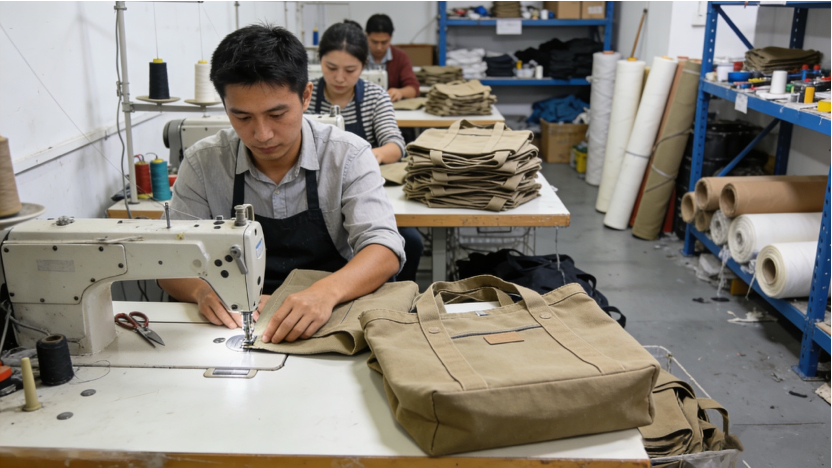
China remains the global leader in bag manufacturing, supported by a highly integrated and efficient supply chain. From raw materials and accessories to production and logistics, nearly every step can be completed within a concentrated industrial cluster.
This level of integration allows for faster product development, better quality control, and more efficient communication between suppliers and buyers. In addition, China’s manufacturing sector benefits from decades of experience, skilled labor, and increasing automation.
For example, in major production hubs like Guangzhou, suppliers are capable of handling everything from initial design and sampling to large-scale production within relatively short timelines. McKinsey & Company highlights that many global buyers are adopting “China +1” strategies to balance cost efficiency with risk diversification.
Southeast Asia: A Growing Alternative
Countries such as Vietnam, Cambodia, and Indonesia are gaining attention due to lower labor costs and favorable trade agreements, particularly with Western markets. ASEAN Secretariat reports steady growth in Southeast Asia’s manufacturing sector, driven by foreign investment and trade advantages.
However, Southeast Asia’s manufacturing ecosystem is still developing. Many factories rely on imported materials, often from China, which can add complexity and extend lead times. In addition, production capacity and technical expertise may vary significantly between suppliers.
While the region offers cost advantages, it may not yet match China in terms of efficiency, flexibility, and supply chain completeness.
Key Factors to Consider When Sourcing
When choosing between China and Southeast Asia, businesses should evaluate several critical factors:
| Factor | China | Southeast Asia |
| Cost | Higher labor cost, but efficient processes reduce total cost | Lower labor cost, but potential hidden costs |
| Quality & Capacity | Consistent quality, large-scale production capability | Quality varies, limited capacity for complex orders |
| Lead Time & Flexibility | Fast sampling, flexible MOQs, quick turnaround | Longer lead times, less flexibility |
| Supply Chain | Fully integrated ecosystem | Dependent on imported materials |
| Risk Management | Stable infrastructure and predictable operations | Varying levels of political and logistical risk |
| Sustainability & Compliance | Increasing ESG standards and certifications | Improving, but inconsistent across regions |
Overall, while Southeast Asia may offer lower upfront costs, China often delivers greater efficiency and reliability—especially for projects requiring customization or fast turnaround.
Recommendations & Strategic Approach
Rather than viewing China and Southeast Asia as mutually exclusive options, an increasing number of businesses are shifting toward a more flexible and strategic sourcing approach. Instead of committing to a single region, they are leveraging the unique strengths of each to optimize efficiency, cost, and responsiveness in a constantly changing global market.
1. Leveraging China for Speed and Customization
China continues to stand out when it comes to speed, flexibility, and technical capability, making it an ideal choice for projects that require a high level of coordination and rapid turnaround. It is particularly well-suited for product development and sampling stages, where close communication and quick adjustments are essential. In addition, China excels in handling customized or complex designs that demand advanced manufacturing expertise. For businesses facing urgent orders with tight deadlines, the country’s highly integrated supply chain enables faster production and delivery. It is also a strong option for promotional and corporate gift bags that require detailed branding, as manufacturers are experienced in delivering consistent, high-quality customization. Many established suppliers can manage the entire process—from initial concept and prototyping to final production—allowing brands to streamline operations while saving both time and cost.
2. Utilizing Southeast Asia for Cost-Sensitive Production
Southeast Asia, on the other hand, offers clear advantages for companies that prioritize cost efficiency over speed or flexibility. It is particularly suitable for large-volume orders where economies of scale can significantly reduce unit costs. Businesses with standardized product lines, which do not require frequent design changes or complex customization, can benefit from the region’s competitive labor costs. Additionally, Southeast Asia is a practical choice for long-term production with stable and predictable demand, as it allows companies to maintain consistent output at a lower overall cost. For these types of operations, the region serves as a viable and increasingly attractive alternative to China.
3. Diversifying the Supply Chain for Greater Resilience
In today’s uncertain global environment, relying on a single sourcing location can expose businesses to significant risks, including supply disruptions, policy changes, and cost fluctuations. As a result, many companies are adopting a dual-sourcing or multi-sourcing strategy to enhance resilience. By distributing production across both China and Southeast Asia, businesses can better balance cost efficiency with operational flexibility. This diversified approach not only mitigates risk but also enables companies to respond more effectively to market changes and unexpected challenges.
4. Prioritizing Supplier Capability Over Location
Ultimately, while regional advantages are important, the success of any sourcing strategy depends more on the capabilities of the supplier than on the country itself. A reliable supplier should demonstrate strong communication skills and responsiveness, ensuring smooth coordination throughout the production process. Transparency in operations is equally important, as it builds trust and reduces uncertainty. The ability to support sampling and product development is another key factor, particularly for businesses focused on innovation and customization. Above all, consistent quality control is essential to maintaining product standards and brand reputation. Selecting the right partner can significantly minimize risks, improve efficiency, and contribute to long-term business success.
Conclusion
As global trade becomes more uncertain, sourcing decisions must go beyond simple cost comparisons.
Southeast Asia continues to grow as an alternative manufacturing base, particularly for cost-driven production. However, China remains unmatched in its ability to deliver speed, flexibility, and integrated supply chain support. Deloitte points out that while Southeast Asia is gaining momentum, China continues to lead in manufacturing sophistication and ecosystem integration.
For most businesses, the most effective strategy is not choosing between the two regions, but understanding how to leverage each based on specific needs.
By adopting a balanced and strategic approach, companies can navigate uncertainty while maintaining both competitiveness and stability in their supply chains.
